

Steph Littlebird
On being an extension of the land, art as renewable purpose, contradicting indoctrination, enoughness, the artist as record keeper, and how ICE isn't new.
Steph Littlebird’s writing and art are prophetic. Steph is an artist, author, curator, and enrolled member of Oregon’s Grand Ronde Confederated Tribes. We met when I was a professor at Pacific Northwest College of Art. I loved teaching there for two reasons: 1. Artists already see their work as constructive, so they more easily welcome the idea that the world and our concepts about each other are constructed too; 2. I got to meet incredible human beings like Steph, who taught me new ways of thinking about, responding to, and remaking the world.
And her teaching continued in our most recent conversation, which I’m excited to share with you. Steph’s ideas about art as a renewable purpose, about artists as record keepers, and about the power of reclaiming a symbol that’s meant to destroy you will stay with me for a long time. So will her words about enoughness and how she deals with racist trolls.
You can buy some of her work on Etsy (I love her “Land O Fakes”), see her incredible art on her website, follow her on Instagram, and pre-order her new children’s book YOU ARE THE LAND.
(I’d love to know what resonates with you in our conversation. Please leave a comment below.)
Before I turn to Steph, a couple announcements:
Enrollment for all of my 2026 workshops is now live. Most WORD CAVES are sold out, but there are still a few spots in the WORD RIVER and RIGHT TO WRITE:
If you missed my free workshop, MAGIC & MUSCLE FOR THE END TIMES, you can watch a recording here.
Now, let’s learn from Steph.
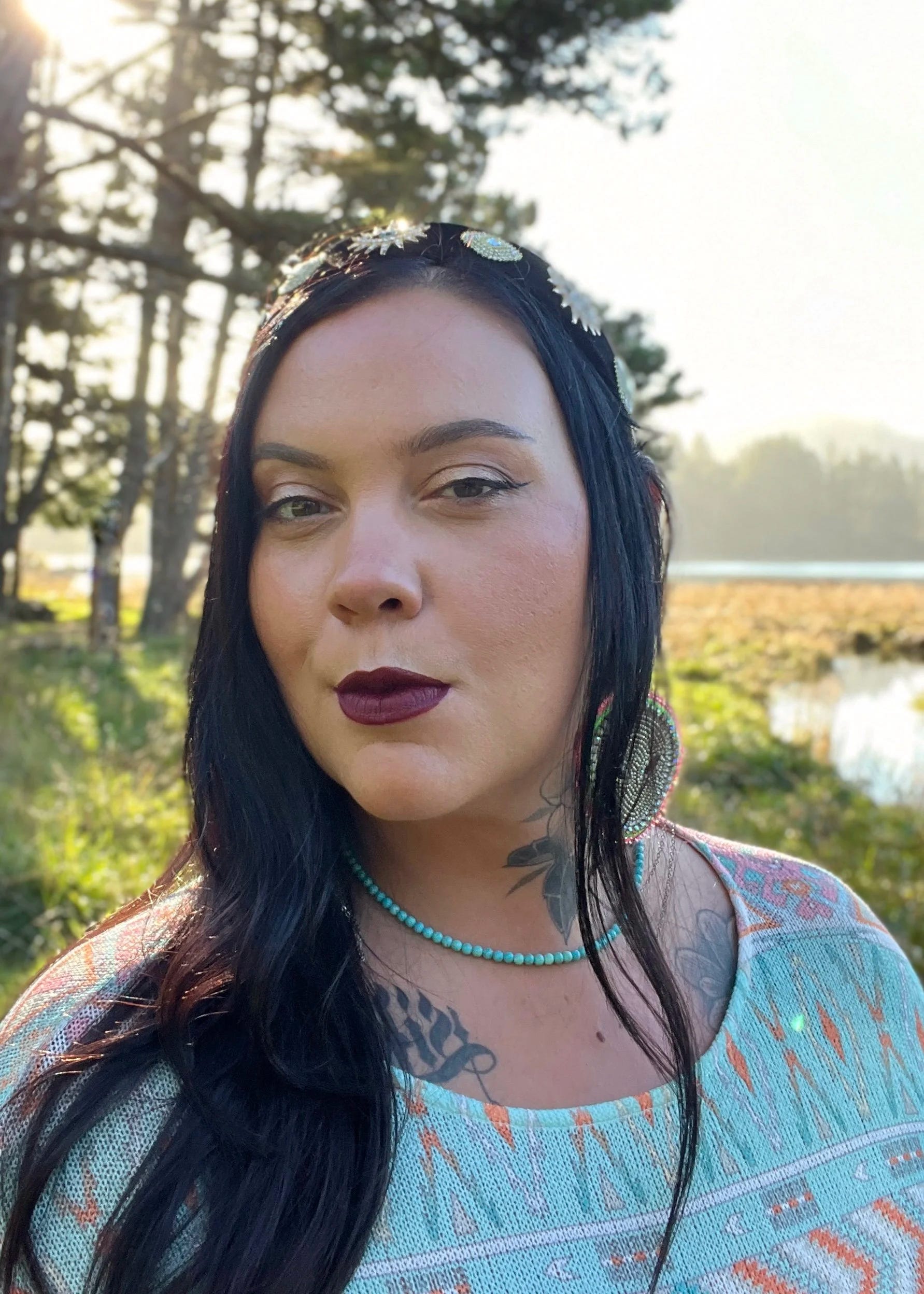
You can watch our entire conversation using the video link above, or you can read the transcript below, edited for clarity. I’ve also bolded l NibLit’s three questions, so if you want to jump straight to her brilliant answers, please do!
SS: Steph and I met at PNCA. I was lucky enough to be her teacher, but she taught me so much about art and creativity, and ways of looking at what it means to be human and part of this beautiful planet. I’m thrilled, Steph, that you took the time to talk with me today, and I can’t wait to have this conversation. Thank you so much.
And first, I want to show off your two beautiful books here, and then I want you to show off your third: Fierce Aunties and My Powerful Hair. Look at this beautiful artwork that she makes. She’s the illustrator for these books, and I want to show people watching this picture, that she says was based a little bit on me. I’m definitely more stylish in your book, and more fabulous, than in real life, but whenever Griffin sees it, he goes, “Mama!”
SL: Oh, I love it.
SS: How did you start doing illustrations for children’s books?
SL: I got out of art school, and after sort of recovering from that indoctrination for a couple of years, I was looking for ways to expand my knowledge, and so I decided to just buy an iPad and learn to do digital illustration, on my own, expanding my mediums, and when I was doing that, I just started sharing it on my Instagram . . . After doing it regularly for, like, maybe, a year and a half or so, I just started getting offers from clients to do work. It was really crazy to go from being a dedicated painter, who did get commissioned regularly, but, you can only sell a painting once. Whereas, . . . I sell prints of illustrations constantly, and so there was something about that shift to that medium that really transformed my career. That’s actually where the publishing industry found me, on Instagram.
SS: No way!
SL: Yeah, my agent found my Instagram account and was like, we need more Native illustrators, and your style would really lend itself to this medium, this format of children’s books, and so I was like, oh my gosh! I never saw myself doing that, because when I did take an illustration class when I was at PNCA, and I saw how hardcore it is, I was like, I don’t want to draw that much. I was a painter, and drawing was really just a means to an end, and now I draw all the time for my work . . . I love doing it so much, and it’s my work serving its highest purpose in children’s books.
SS: Tell me more about that. What do you mean? What’s its highest purpose?
14:36:01 Well, to me, I have always wanted my work -- I know that you know this; it’s how it functioned when I was in school – [to be] political art. But really, at the core of it is, like, this idea of sharing my knowledge with other people, and sharing my love with other people to let them know more about the world and about themselves. I’ve always seen my work as in the vein of activism.
And so, these books, to me, are very much in that idea of serving community. I am serving the next generation, and through the stories that I choose to help tell, I am getting to bring more positive affirmation and representation to Indigenous children . . . A huge part of my work as an artist was originally like, there is a lack of representation of my community, and I want to create more representation, but it took me a while to really figure out what that meant . . . Now I feel like it’s happening through children’s books and also through my more, adult or political illustration content on Instagram that is kind of separate from children’s books. They’re very much informed by each other, and they’re [based on] the idea of serving my community through my work.
It all goes back to my thesis work, communicating all these concerns I had for the world through this visual language, and now I’m trying to put that into action through creating the positive representation and creating the thing that I saw was lacking in the world when I was a younger person.
SS: I wanted to talk about your thesis work a little bit, if it’s not too far away, because I was thinking about how your artwork has always been steeped in symbols and language, and now you’ve written a book, which I want you to talk about also. How do you see the connection between that art that I got to witness, where it was creating a language, and entering the world of books, which is also a world of language. How do those things feel connected to you? You might need to describe your thesis, because these people probably didn’t get to see it.
SL: Oh man, it was over 10 years ago now, but, my thesis was to create a visual language that engaged with political thought and conversation [and] critique of the current political administration, and it was through this language that looked like petroglyphs, but it also incorporated emojis and more contemporary representation . . . That was me really starting to think about the meaning of an image, and how an image can be interpreted, how it can be used to communicate all these ideas without any words at all.
When I made that work, I got a lot of pushback from very progressive professors . . . I remember my midterm review being hard, because people were like, Oh, Barack Obama’s in office, there is no problem with racism or mass surveillance or police mentality, and that was really hard for me to understand, and now I think, wow, my thesis work was prophetic, and my thesis work is more relevant today than it was then.
I really am so glad that I went through that, because it taught me to think more intentionally about everything that I do, and that includes who inspires my work. Like, in Fierce Aunties, there is an auntie that is modeled off of you because you taught me the power of education, you taught me the power of reading really hard stuff and analyzing it. You may not understand, but I came from a town of 500 people, and so learning from someone like you was transformative, because you came from a world that I did not come from, but you still treated me like I had the capacity to understand . . . I learned so much about myself and the world, and how much power I actually had in it.
I really see your classes as being instrumental to me really trying to keep turning up the power of my political work. That comes from the reflections that you did in your own life . . . When I think about your books and think about Breaking up with God, . . . your transformation is something I think about still, and it just shows you that any point in time, you can flip a switch and be liberated in so many ways. That’s why art is so powerful, and why books and words can be so powerful . . . You really taught me that art is a weapon, and if we use it right, we can really do some amazing, powerful things with it.
SS: And you are doing amazing, powerful things with it. All of those things that you said you got to learn in classrooms with me, those all belong to you. I was just helping you remember that this is you. This is your intelligence, your brilliance, your way of seeing the world.
And I think [you’re] also informed by being Indigenous and being Native and living on this land that was stolen. I think a lot of your art comes from that. . . . As we find ourselves in this particular political situation, I was talking with Anthony Hudson recently, and he was like, this is not new. You know, the apocalypse has been here for a long time, and I feel like you’re best equipped to respond to this political moment, because it’s not new to you. It’s part of a long tradition. I was wondering if you want to speak to that at all.
SL: We’re seeing the same things play out, and it’s something that I learned from many of my history teachers: If you don’t learn history, we are doomed to repeat it. . . . I’m lucky enough that I grew up in a community that really cares about history and talks about its history, both through a historical lens of [how] America might think of history as, like, these events happened, but then also our ancestry, our traditions, our lineage upon the land is so important to us, and knowing our history is part of that tradition. I feel really grateful, but the work that I do requires me to know all of those things. And that, in itself, is a lot, because we can see it. We can see.
I knew a long time ago what was gonna happen with Donald Trump, even so much as, moving back to a blue state, because I was living in a red state and knew that when he got back into office, I needed to be somewhere else. . . . I knew those things, and other people were like, you’re crazy! You’re crazy, and it’s like, Well, you can just keep calling me crazy, but my ancestors lived on reservations and weren’t allowed to leave them legally, and seeing these programs of assimilation and oppression happen in other places in the world, like Palestine, the Gaza Strip, that is what a reservation looks like. When you have a person stopping you from leaving, and you are landlocked, that’s a reservation!
The programs that are being implemented there are very, very creepily, eerily similar to what was done to our people, just a few generations ago. It’s very easy to see what’s happening if you are a student of history and also coming from a marginalized community. We can see it. . . . Border Patrol and ICE, all of those things are very familiar to us, because that’s really just what the Bureau of Indian Affairs was for us . . . We had BIA agents that monitored us and would not allow us to leave our reservations. [We were] only allowed to leave if we were with a BIA agent. So we’re seeing all these things play out again.
We actually just had DHS [Department of Homeland Security] on the reservation in Grand Ronde about a week ago, and it was very scary. They essentially went into a lockdown process like you would with an active shooter. Just thinking about the psychology of doing that, going on to federally protected lands with Indigenous people, who absolutely belong to that place.
SS: Like, the opposite of an immigrant.
SL: You know, it’s like, what are you doing? But actually people are like, what are they gonna do? Send you back to where you’re from, which is where we are from, right there. That’s the sort of illogical nature of white supremacy . . . all of the things that it tells you aren’t really true, because they just change depending on what’s convenient at the time. And so, absolutely they will deport us if they think that we’ll be better off in an encampment somewhere.
They just announced they’re opening up a homeless encampment, which, I can only imagine is going to end up being something we regret when we look back historically.
Seeing it live is crazy and also tells me a lot about history. I always wondered how anyone let the Holocaust happen. Like, how did it happen? What was the mentality? Now I can see it playing out – once you can turn people against each other, once you can demonize someone, that fear controls people in a way that’s really inexplicable and goes beyond logic. It is really just fear. They’ll do all kinds of things, and even just look away when horrible things are happening, out of their own fear. That’s what they did to Indigenous people. We were called witches; we were, you demons, because we could be in the forest at night, you know, things like that. This is so familiar to us; it’s like a different time, but same symptoms.
SS: You made some really brilliant connections there. Thank you for that. And I’d love it if you would talk about your book that you’ve written, and I also want to talk about the exhibition that you’ve done. Is it opening in different spots?
SL: The book is called You Are the Land. [You can pre-order YOU ARE THE LAND here.]
SS: That’s so brilliant. It gives me shivers on my body to hear. It’s so beautiful.
SL: I’m very proud of it. I have been doing books for other people and actually getting to write and illustrate the whole thing by myself, it’s really cool. Penguin bought it, so it’s gonna be everywhere, and that is just kind of mind-boggling to me.
It’s essentially a story told through a child who is growing and learning through family and community that it belongs to the land, the land belongs to it, that it is a part of the land, and sort of everything within its world is connected back to the Earth. The reason why I feel like that is so important is because climate change is upon us. It is becoming more and more apparent every year, and we are approaching some pretty serious crises, and my biggest concern is that the young people are being robbed of their future.
Teaching the value of being connected to the land is something that has been in my work for a really long time, and I know based on my social media following, it really resonates with people. So, my agent suggested I write it as a children’s book, and the idea of reaching younger people with this concept of them actually being an extension of the land rather than being something that lives on the land, you know? And I’m just lucky that I have a cultural background that teaches me this idea of being one with the land, being an extension, as opposed to a separate from it. But actually, that’s true of all human beings. It’s my way of teaching this Indigenous cultural value to young people, and while it does cultural references, like powwow references, it also has protest references . . . I am really proud of it, and it’s dedicated to my tribe, because I wouldn’t be here without them.
They’re the reason I even got to go to PNCA and could afford to go to a private art school and be with people completely out of my realm of imagination, like you. Meeting you is, like, crazy to me, this person who came from the background that you come from and had so much success and whatever, so I feel so blessed, because I get to sort of give back in that way through the story.
And then I have the Transgressors exhibition, which I’m in, and which Anthony Hudson actually curated, and that is focused around Two-Spirit identity, which is an indigenous-specific queer identity. What’s cool is that Two-Spirit encompasses so many different things. A Two-Spirit person, could be trans, they could be bi, they could be gay, they could be, a number of things, and for me, it really represents gender fluidity. I have never fully felt like a lady or a guy. I just kind of feel like it depends on the day.
For a long time, I felt like an alien because of that, but it was actually when I went to PNCA, and I saw Anthony’s performance of Looking for Tiger Lily [that I was] learning about the Two-Spirit term. Because I came from conservative Natives; I came from a conservative Native family that had very much been assimilated through the church. So queerness was not discussed. And then I was also from a very small town, so those points of knowledge that access even just language of describing oneself, I didn’t have it. Meeting Anthony was just this explosion of my mind in terms of my identity, and hearing what Two-Spirit meant, and realizing, oh my god, this is who I have been my whole life, and I just never had the words for it. And so, being part of that show is this amazing full circle for me, because Anthony was totally part of my transformation in terms of me knowing who I was as a Native person, and that ties back to that idea of serving community. . . . Many Two-Spirit people feel like we have a responsibility to serve our community. I’ve always felt that way, that part of my purpose on this earth is to give back to those who have given so much to me . . .
I recently just had my own exhibition funded with the Oregon Creative Heights Foundation, and . . . . what I proposed to do, [and] I can’t find anything else in America, so I’m guessing it’s the very first one, is an all Indigenous biennial that will be reoccurring every two years, and it’s called Indigenous Northwest . . . In the Pacific Northwest, there are so many amazing Native artists, and some of the most famous artists on the planet that are also native. They just all happen to live in the Portland area. It says something about the community, the culture that we come from. Also, tons in Seattle, so it’s up and down I-5, there’s just a bunch of us making incredible work. In my work as a curator, I want people to look at this community regularly. We should be giving more space to Native artists, because they’re doing so many amazing things . . .
SS: I want to ask you a little bit about that practice, because you’re a visual artist, you’re an illustrator, you’re a writer, you’re a curator, you make instruments -- you paint those drums, right? . . . Magnificent work. How do you understand all those practices connecting to each other?
SL: Going to art school was really weird for me, because it is so siloed . . . You go for a discipline, and that’s supposed to be the one thing that you do, but if you go to a cultural event in my community, people do all kinds of stuff. We’re jacks of all trades . . .
I might do an illustration for a client, but I am probably never going to paint a drum for a client. Those are gifts. What’s really cool is that some of my practice is really client-focused because the people who are making children’s books are essentially always going to be clients, but then I get to make beautiful pieces of art for people in my community as gifts. That’s another part of our cultural tradition, gift-giving, and if you see somebody who is a really amazing person in your community doing amazing stuff, make something for them. Give them a gift to show your appreciation. When I’m painting drums, it’s because I’m giving it to someone who is really instrumental in my community, and I want them to know that their voice is important, and they should make it even louder, you know?
SS: That is so gorgeous.
SL: Some of the work can still remain very symbolic, which goes back to the thesis again, . . . and some [is] much more straightforward and capitalistic, [and] some are very much rooted in cultural tradition.
NIBLIT 3 QUESTIONS
SS: QUESTION 1: I want to shift over to these NibLit questions that I’ve asked everybody I’ve interviewed, and the first is: What brings you back to the desk? But desk might not be the right word. . . . What keeps you coming back to making your work?
SL: Community for sure, but I think, if I’m being completely honest, without art, I would not really have purpose. And I think purpose is what makes a life really that much better, you know? It’s like, we come into this world, and we’re sort of expected to get a job, and have kids, and do all the things that are prescribed to you, but what purpose is there in that, other than fulfilling the thing that has been told to you?
For me, art is this renewable purpose; my art can do so many different things, like we were just talking about. It can be used as a tool in so many different ways. I keep coming back to it because it gives me purpose, it gives me a reason to live, it gives me hope, it gives me resilience, you know? For me, it is a mode of survival, ultimately.
Even as a young person, I grew up in a weird house that had lots of violence and addiction in it, and art was a place for me to escape to; it was a place that was safe for me to express myself. And it’s still that way now. It is this safe place for me, and now, it’s more than that, which is really cool, but its original purpose was a safe place . . . I’ve always noticed, if I’m not practicing, if I’m not making art, it’s a bad sign. It means that I’m in sad places, because art is the thing that keeps me tethered to reality.
SS: It’s so interesting that you use that phrase, tethered to reality, because I was thinking about your thesis work and your symbol work, but also how . . . some of your art looks at symbols that have been perverted by white supremacy, by capitalism, and returns them to how we should have seen them before.
I’m thinking about your work around . . . Pocahontas, or your work around the land of… what’s that butter called? Land O’Lakes Girl, or woman, whatever language you want to use. You see these reversals that have happened in dominant culture and white supremacy, and you’re turning them back. You’re almost returning those symbols to a safe and powerful place. Can you talk a little bit about that work that you do with those symbols.
SL: I’ve been working a lot with the historical representation of Indigenous people, specifically females, because we’re always hypersexualized and really not given a voice. We are always tokenized in our representations as supporting usually white men, like Pocahontas or Tiger Lily in Peter Pan . . . What I have noticed is that Indigenous women don’t really have a whole lot of consent. We aren’t asked about our stories. We’ve had stories told about us, and so by taking those images back, I’m giving them a voice.
It first started out with them just being like this. [raising middle fingers] You know, a lot of them were just doing this.
SS: It’s just so powerful to do!
SL: And at first it was just me being like, fuck these representations. I know that if these were real women being represented, they would be pissed that Disney had commodified this image.
When you think about the history of Pocahontas and the true story that she was essentially a victim of child sex trafficking, the commodification of her image is really disturbing. It says something, I think, about the underlying culture of colonialism and this idea that Indigenous women are a resource to be extracted, and that remains true now, you know? We have the MMIW (Missing and Murdered Indigenous Women) movement for unfortunate reasons, which is that Indigenous women are constantly vulnerable to abuse and just literally being disappeared off the face of the earth. For me, it’s important to give those representations their voice back, and to be like, let’s go ahead and clarify some things about this representation. This is how old she was, this is what was happening . . . This is the reality of the story you’ve been told, and that work has been really powerful.
The most viral of my work has been the work about the Pocahontas and Disney representations, like Tiger Lily. It’s because people were really indoctrinated by those pieces of art, and by contradicting their indoctrination, people have revelations. People get really mad. People feel conflict because they love the film, but also recognize it’s problematic. It’s a way to educate people. It does make people pissed, but also, I think that speaks to its power. It’s fun, but it’s hard work, too.
SS: How do you deal with the people that project hate towards you? Do you just ignore it? What’s your strategy for that?
SL: At first, when it was happening, when I very first was working on Pocahontas, that was when I started to get the most racist stuff I’d ever had on my account, and at first, I turned off my comments. I just didn’t want to deal with it unless you were a follower of mine, and most people who were trolls are too lazy to follow you and then comment, so they would be deterred. But I turned on my comments earlier this year, and I don’t know why I did it, but what happened is that I realized something about the algorithm, which is that it wants you to turn your comments on so that people who get mad will comment on your account, and then it blows up the post. And so, that’s what happened. I basically had a piece go viral, and really an explosion in the racist trolls. And something in my brain broke. I don’t know, it went from me being very fearful of the confrontation, because I grew up with really aggressive men [and] being quiet was the safest way to survive those environments, but there was something about how stupid these responses were, because they all were from a script. They say the same exact stuff, and it’s kind of comical, because they’re clearly just indoctrinated, and they don’t actually have any backup. They don’t really know anything about their opinion, right? They don’t have any historical precedent or context for it. There was something about it that instantly demystified them and made them have far less power over me. Now I think it’s hilarious, and it’s really easy for me to spot it. It’s also much easier for me to spot it in real life now. There was something about confronting the fear of that racism, how mean people can be, and now it doesn’t actually hold that power over me anymore. I feel good about that. But it’s not fun . . .
I just had one go this week because of Halloween, and people really like to dress up as us for Halloweens. It’s a small price to pay, and my ancestors went through way worse, so it’s on me, it’s my responsibility to speak the truth, you know.
SS: It’s really powerful, and it’s really powerful for the rest of us to try to protect the people who are speaking the truth, to be alongside you in that work. That’s a great reason to come back to the desk: to speak the truth.
QUESTION 2:
SS: I was wondering, and this is related to the critic question, because I think you have so much medicine to offer to people . . . when we choose to be artists, in some way, we’re choosing to be in relationship with our own critics, whether that’s external or internal, from how we’re raised to what it means to be in the bodies that we’re in, in our particular time in history. But I’m wondering if you have a sentence that plays on repeat in your head that gets in your creative way. And if you do, what’s the antidote to that?
SL: The only thing that gets in my way is that feeling of being enough. Like, do I have enough of a skill set to execute this? That tends to be the thing that gets in my way. What I have realized over time is that, yeah, I do. I will figure it out, you know? And, if I don’t, I actually know I’m so lucky to be in a network of artists, and that’s what’s cool about being an artist, is that there are so many people in our community that want to help each other, and so if I have a question, there’s probably somebody I can ask who can help me figure out the answer to it. I think the enoughness is something that’s a thread throughout my entire life, but it also comes into the art world because when you go to school with so many talented people, you’re like, oh, do I even have anywhere near the level of talent that I am thinking I have?
When the publishing industry became aware of my work, I was like, really? Like, okay, if you guys say so, I’ll try, you know?
SS: Your work . . . is exquisitely beautiful . . . What is it like to create images for someone else’s language?
SL: It depends on the person you’re creating the language for, so sometimes it’s really great. The author of My Powerful Hair, Carol Lindstrom, we became, like, besties, and we talk all the time still, and I feel really grateful because I’ve been told that’s not necessarily the case, obviously, with all illustrator-authors. . . . But for the most part, what’s cool about the publishing industry is that they hire the artist because the artist is supposed to know what they’re doing, and they treat artists very differently in the publishing world than they do in the fine arts world, and that’s a lot of the reason I put more of my effort into that world, because I’m treated more ethically. I don’t spend my time chasing down gallery shows when I could just be trying to write a manuscript or something like that . . . You’re given a lot of freedom, and sometimes an author might have some ideas or directions because maybe it’s a personal story, particularly me doing cultural representation. Sometimes it’ll be like, this is a specific tribe, so the information or the representations of that tribe’s regalia, that has to be really specific . . . It’s made me more confident in my art. Going to art school and having all of my professors give me a hard time about my color, and be like, there’s too much color, and that’s what I’m known for now! . . .
SS: But that’s such good advice for everyone to remember. That’s what makes your work your work, and sometimes the things that we’re criticized about most are actually our biggest power, and what will draw people to our work.
SL: If people are that compelled to be like, don’t do that or whatever, there’s something in it, because they’re still being triggered by it in some way, so there’s a power in it that you just have to harness, you know?
QUESTION 3
SS: I like thinking about it that way. And I’m curious, and this might not be the right question for you, but I was going to ask if you have a favorite writing prompt, or maybe there’s a favorite making prompt that you have.
SL: I think my prompts are usually just gonna be based on reactions to what’s happening in the world. My prompts are really in response to the world at large. I’m a news junkie, so I’m always paying attention to the world and figuring out what’s happening today, and a lot of the work that I’ve made recently has been in response to what’s happening with the ICE raids here in Portland, and what’s happening on the larger scale with our government . . . It’s like, my work is my tell. It tells you what I’m thinking about, because I can’t help it, it’s where it comes out. My work is really reflective of the world that I’m in, which I think is the important part about being an artist. We really do try to mirror the things that are happening so that we can be a record keeper of this experience in the ways that our creative predecessors have been. My prompts are usually reactionary and have to do with a current event.
SS: That’s a great way to think of them, though, as art props . . . It seems connected to how you’re thinking about the people who are writing horrible comments on your Instagram. To turn the news into an art prompt is another way of turning a symbol on its head and letting it be generative, when it’s meant to be destructive in some way to you.
SL: I think about the power of transformation as the same thing that’s happening in the Pocahontas work. It’s like, Okay, I’m gonna take this thing that represents something really shitty, and figure out a way to make it work for me too, like reverse it, flip it on its head, or educate people. When stuff is happening in the world, like what’s happening with the ICE raids, it’s like, okay, now I gotta make work that educates people, that clarifies misconceptions. That’s how I see my work functioning. Because it has purpose, that purpose can sort of be activated at any time, and particularly as creatives, we don’t give ourselves enough credit for how much power we actually have. We are the culture makers.
This conversation with Steph was such good medicine to me — the power she has to reclaim symbols, how she shifted her relationship to racist trolls, how she recognizes that indoctrination can be undone.
What moved you?
What will you take away from this conversation?
Are current events ever like prompts for you?
What idea did Steph share here that changed how you think about your own creative practice?
I can’t wait to hear from you!
Next up on NibLit: Darcie Dennigan! She’s a poet and a fiction writer and a professor — and she’s the first NibLit guest I cold-called based on an essay she wrote for LitHub about writing in cemeteries that I loved. I’m so glad I did.
Looking for more writing inspiration?
Check out Can We Listen to Something Deeper, a free workshop recording with special guest Pádraig Ó Tuama, host of Poetry Unbound (one of my favorite podcasts on the planet!).
Interested in Word Project Workshops?
Check out the new round of RIGHT TO WRITE that starts in April 2026, my monthly generative writing workshop series. Two hours of generative writing prompts on a theme, every month. I love this workshop, and if you miss the live sessions, they are recorded.
The idea or the power in letting what’s happening in the world be your prompt… this was a beautiful conversation 💛
The power of transformation, the ability to take a negative and flip it to a positive, is a goal I want to incorporate into more of my poetry.
I have written about my past in a few poems but being a naturally private person I don’t go there much.
But the idea of transforming something unpleasant into something that I can point to with pride is something I plan to pursue.