

DARCIE DENNIGAN
On writing in cemeteries, the importance of wasting time, never doing anything for accolades from other people, and the Hippocratic Oath every creative writing professor should take.

Darcie Dennigan is the first writer I cold-contacted for NibLit. I read her brilliant essay “In Praise of Writing in Cemeteries,” and I wanted to be her friend. I interviewed her in November 2025, but I just got around to transcribing it this week(!)— and re-hearing what she had to say was just the medicine I needed at this time.
Darcie is a poet and a novelist and a professor at the University of Connecticut. She shared that she has never had a critical voice in her head when she’s writing. Can you imagine?! That is mostly true for me now, but it’s something I had to practice and heal and learn over the past 30 years of writing seriously. She’s experienced that from the beginning — and she’ll help you get there too.
In our conversation, Darcie talks about writing as a place of freedom — untouched by capitalism and productivity and approval. This conversation felt like permission. To waste time. To refuse to be good. And to pee outside (you’ll understand, I promise).
You can watch the interview or read the transcript — and I hope you’ll share in the comments what stays with you and if you experiment with her writing prompt suggestion.
I. “NO ONE ELSE IS ALLOWED IN MY HEAD.”
SS: Hi, Darcie, thank you so much for being here with me to talk. You’re the first cold call I’ve ever done for this NibLit series. I loved the piece that you wrote in LitHub so much. It was electric, and it changed how I think about places to write, and why we write, and what it means to be a writer. I just felt like, I have to be this person’s friend, so I wrote you right after I read it. It went to your spam folder, so I didn’t hear from you for a while, and I was like, oh, I came on too strong. But then I heard from you, and I’m really glad we get to talk. Thank you very much for being here.
DD: Thank you so much. Thank you for reaching out, too, because you know how it is. You write something and it goes into the void, and you think, well… there’s no lack of void, to quote Samuel Beckett. So it’s really lovely when you hear from somebody who’s not your mother’s best friend.
SS: Yeah, I feel that. Well, I’m glad. I’m glad it was received that way, because what you wrote really meant a lot to me.
I want to talk about what you opened with, which was this line that made me keep reading. You said, “I’m not sure how to survive without writing.” So I’m wondering if you could talk a little bit more about that. I feel that, and I’m curious how you feel about that.
DD: I knew you were going to ask me something around this, and I was trying to think of ways to talk about it without sounding pretty much full of crap, but I’m not sure I’ve hit upon it.
There’s a couple of things. Sometimes, going about my daily life, standing in line at the grocery store or doing every mundane thing, I think — when I’m bored or feeling the absurdity of these pointless tasks like laundry — oh, but I have writing. There’s something I can use to justify my existence to myself. I don’t think anyone needs to justify their existence, but to myself, writing is the thing that makes me feel the most alive, and also the place where I can be the most myself. I don’t have to slot myself into one of the many roles that people, and especially women, have to slot themselves into.
“Writing is the thing that makes me feel the most alive, and also the place where I can be the most myself. I don’t have to slot myself into one of the many roles that people, and especially women, have to slot themselves into.”
SS: I feel something similar. I wouldn’t have described it that way, but it’s almost like this private space that can’t be touched by any of that other stuff.
DD: Yeah, exactly. And I think also, I don’t make money from writing, so I never feel any obligation to anybody or anything, whereas in every other sphere of my life, of course, I’m pulled and torn.
But it’s also the only place where I feel like I’m not judging myself, and I’m not judging my thoughts.
SS: Has that always been true, or has that kind of freedom from judgment been something you’ve had to cultivate?
DD: I think that’s always been true, and I think that’s why I’ve always wanted to be a writer. I never planned to be a writer or teach writing, but I was always writing or knew I would write alongside whatever else I was doing.
I don’t know how that happened, but I am such a weakling in terms of my security in every other place. There are only a couple things I don’t beat myself up over, and writing is one of them. I think because it is a private space and no one else is allowed in my head at that time — except other writers I love.
I’ve never had a critical voice with it. I mean, not until I revise something, but that’s different. It always feels really apart from me, no matter how personal it is.
II. A HIPPOCRATIC OATH FOR CREATIVE WRITING TEACHERS
SS: That’s incredible, because I lead writing workshops for writers, and I feel like a lot of what I’m doing is helping them navigate the voices inside their head and claim permission that I think is their birthright.
So I’m curious — you teach writing. Do your students have that kind of freedom, or is that something you’re helping them uncover or claim?
DD: That’s a great question. I think that’s probably the thing I have to offer my students — a sense that this is the one place you can be free and playful.
Of course, that’s really hard to do in a writing workshop because people are thinking about how their work will be received. But I think that’s what I try to do as a teacher: think about other ways to have a conversation aside from a prescriptive one or a diagnostic one. [I want to find] ways to sit there and describe how a piece is working in a neutral way, so writers feel more comfortable bringing whatever they want to share instead of the perfect polished piece that doesn’t exist.
SS: That’s amazing. I think that’s a rare space. I’ve been in just a few writing workshops. I have a doctorate, but I don’t have an MFA, so I wasn’t really in workshops except for some summer programs and things like that. And I was in a lot of mean ones. People were mean, trying to posture for the teacher or professor.
So I’ve worked really hard to create a space that’s almost the opposite. I have my people keep their writing to themselves, and we talk more about process and craft and how to create a writing life. But it’s because of workshops I’ve been in that sound like the opposite of your classroom.
DD: I don’t know if you ever feel this way, but as a teacher it’s really alluring. You know you could easily be like, “Here’s what’s wrong with this poem,” and they would love you and respect you. It’s like they like you more when you beat them.
My students often get frustrated with me because they want me to say good or bad, and I try to always put it back on them.
I know it’s annoying to them, but I want them to write their whole lives. Writing is something available to everybody, and if they’re only writing for this outward stamp of approval, I might help them make their story or poem better in the next five minutes, but I’m not actually teaching them anything.
“Writing is something available to everybody, and if they’re only writing for this outward stamp of approval, I might help them make their story or poem better in the next five minutes, but I’m not actually teaching them anything.”
SS: I think that’s really powerful. I had an undergraduate poetry workshop where the best grade you could get was “NAAB” — “not at all bad” — and the worst was “NAAG” — “not at all good.”
I feel like that does such a disservice to the creative freedom we need in order to do the writing we need to do. You have to write something that might be bad for a long time before you can even figure out what you’re doing.
That neutrality sounds magical to me. It’s encouraging people to trust their own opinion. They don’t necessarily need yours or their workshop participants’. They need to listen themselves into their project.
DD: Right. And I think students find that really frustrating.
But when I think about students whose work is still alive ten years later, it was never the students everybody loved immediately. It was the students doing something weird or chaotic who just loved it and worked really hard and read a lot. Now their writing is gorgeous.
I always feel like it’s a Hippocratic oath. I could harm them, and I don’t want to.
SS: Totally. Who’s to say what’s really good?
I always think about Maya Lin at Yale turning in her design for the Vietnam Memorial and getting something like a B-minus. It’s such a reminder that institutional approval is not the same thing as artistic truth.
And what you’re doing feels really countercultural because our whole education system trains us to perform for approval. You’re saying the approval that matters is yours.
DD: Yeah, and we don’t know how to sit with that.
III. ON WRITING ANYWHERE
SS: I also wanted to talk about your revelation that you could write anywhere. You talked about more alive spaces and interstices, which ended up being cemeteries for you. I wondered if you could talk about that.
DD: I made some choices in my early thirties where I thought, I’m doing this for my writing. And then I became a single parent and realized I’m just going to write wherever I can — outside karate class, commuting, wherever.
I used to feel really proud of myself that I could write anywhere, like teenagers being able to sleep anywhere. Now I’m like, I need an eye mask, earplugs, melatonin.
But the noise helped. It was almost like a noise machine. When there’s a lot of noise, your brain can be quiet.
As for cemeteries, I think when I was writing novels instead of poems, I wanted quiet. I wanted to be outside myself. I’ve always liked cemeteries, and I wanted something that was nature but not fully wilderness. I wanted civilization and nature together.
And looking around at all those tombstones — all those markers of dead people — became a kind of noise too. It quieted my mind in a different way.
SS: That’s amazing. Yesterday I taught a workshop, and one of the women in it is fighting cancer. She was in the ICU, and she came to the workshop from her hospital bed. I just started crying. It made everyone else’s excuses about why we’re not writing evaporate.
DD: Absolutely. And I think when things are really tough, what most writers want to do is make something and be among people making something.
SS: Yeah, it feels like an antidote, especially now.
I also loved this phrase you used — “outside-timeness.” You described reading The Secret Garden in a hot car and feeling completely immersed. I had that same experience with Where the Red Fern Grows.
Do you experience that sense of being outside time when you’re writing too?
DD: Sometimes. That’s probably why I write — because of those experiences as a reader. Looking up from a book and not knowing where you are. Being completely outside yourself. It doesn’t always happen, but I think I’ve gotten better at training myself to get outside time while writing.
And I also think a certain kind of wasting time is really important as a writer. Not using time to do anything productive. Walking nowhere or staring out the window for no reason. It’s a way to get out of linear time.
SS: Or outside the capitalist idea that time has to be productive.
DD: Exactly. And there’s a difference between not being productive by watching Netflix and being genuinely quiet — not consuming anything either.
SS: Julia Cameron talks about that in The Artist’s Way. No reading, no television, just output or stillness. It really changed how I thought about input versus openness.
DD: For me, that was the difference between writing poems and writing novels. With poems, I have books all around me and feel like I’m in conversation with them. But writing a novel, I needed to be really quiet and not have any input on the days I was writing.
SS: I was going to ask you about all the different things you do. You teach writing, you’re a novelist, literary critic, poet, and co-director of this theater group called The Spatulate Church Emergency Shift. Tell me about that.
DD: It’s really stupid, but it’s conceived as being stupid.
It’s a poet’s theater group I do with one of my good friends in Providence. I once wrote a review of a poetry book and realized I wasn’t done collaborating with it. So I staged it.
I got my really dignified friend to wear this giant pink Marge Simpson wig and become the star of it. None of us were actors. But it was so much fun, and I understood the book differently once I put bodies with its language.
We don’t do regular productions, but every once in a while I think, let’s make something together.
The most recent thing we did was based on a poem by Keith Waldrop. We made a film where my friend runs around Providence in this wig while another writer voiced the poem.
No one wants to publish poet theater pieces, and theaters don’t really want them either, so we do them in garages and weird places.
But when my ambition or ego starts eating at me, it’s really good to do something wholly ridiculous that’s just for fun. You can’t really put it on your resume. And it’s collaborative. It feels like a good antidote to social media and careerism.
SS: You’re doing incredible things that cultivate freedom and let you create magnificence. That practice of freedom seems essential to your work.
DD: Thanks, Sarah. You’re putting it together in a way I hadn’t thought of before. It really is about playing around with your friends with words. That’s the thing that will feed you over a lifetime.
I always wanted to be an actor, but I got kicked out of theater school for having a bad accent.
SS: I thought I wanted to be an actor too. I took one acting class in graduate school and the professor basically told me I shouldn’t be there.
DD: That’s bad pedagogy again — crushing people’s dreams.
IV. “IT’S NOT THAT WAY; IT’S OVER HERE.”
SS: The other thing I loved was how you wrote about the body. You talked about getting up early to write and not wanting to wake anyone in your household, so you’d go outside no matter the weather.
Can you talk about how you protect your writing time?
DD: Sometimes I don’t do a good job with it. I don’t do well when I start thinking I want people to think I’m an upstanding citizen — bringing the recycling bin in right away, going to optional parent coffee, meeting every obligation. I have to remind myself those are all exterior ways of showing up to life.
The one sentence that brings me back is from Eugène Ionesco’s The Bald Soprano: “It’s not that way, it’s over here.”
I love that sentence so much. I have to keep telling myself: it’s not over there, it’s over here.
Materially, that means things are sometimes a mess. My daughter drove my car into a bush and half the bumper is falling off. I think, I should bring it in Saturday. But then I think, I really want to work on this piece of writing. So I’ll probably write, and the bumper will hang on with duct tape for another week.
I try not to do anything that would get me accolades from anybody else.
“I try not to do anything that would get me accolades from anybody else.”
SS: I love that. “I try not to do anything that would get me accolades from anybody else.” Those are words to live by.
And “It’s not that way, it’s over here.” That’s beautiful.
So I’ll transition into the three questions I ask everybody.
V. THE NIBLIT 3 QUESTIONS
QUESTION 1: The first is: what keeps you coming back to the desk?
DD: I don’t think I can add much more without blabbering. But your story about the acting class reminded me that I took a creative writing workshop in college where the professor said, “If you have to write, don’t write poems. These are no good.”
And weirdly, it didn’t stop me at all.
At acting school, when people criticized me, I listened. They told me I had no body coordination and my Rhode Island accent was terrible. But with writing, when someone said I was a bad poet, I just thought, wait till I’m a great one someday.
SS: That sounds like a deep knowing that he was irrelevant to what you knew you wanted to do.
DD: Maybe.
QUESTION 2: The second question is: do you have a sentence in your head that gets in your creative way?
DD: I realized when I read your questions that I absolutely do.
My grandmother used to say to me, “You’re such a good girl.”
And I adored her. But that sentence is so pervasive in my family culture. I hear it all the time in my head: be a good girl.
SS: And your antidote is, “It’s not that way, it’s over here.”
DD: Exactly.
SS: I’ve been trying to undo my own good-girl conditioning for twenty years.
One of the things that helped me was realizing that the times I was trying hardest to please people were the times I was in the most danger.
DD: Oh wow. That’s so real.
I had someone mildly stalking me over email this summer, and part of me still thought, I should write back just to be nice.
SS: Exactly. It doesn’t serve us.
QUESTION 3: And the final question: do you have a favorite writing prompt?
DD: Yes. I love Oulipo.
It’s a French literary movement built around constraints. Their idea is that you never wait for inspiration. What you need is a rule. Once you’re busy with a rule or a constraint, your brain becomes free. They call themselves “the rats who build the maze from which they must escape.”
One simple Oulipo exercise is called N+7. You take a piece of writing and replace every noun with the noun seven entries later in the dictionary. I once did it with my divorce agreement.
It shakes up meaning just enough that you can suddenly see your writing differently.
SS: That sounds amazing. I use a lot of generative prompts in my workshops too. I think constraints help because they keep the critical part of the brain busy so something freer can emerge.
DD: Timed writing is so good for that.
SS: Well, thank you. I had this feeling while talking to you that we’re going to be friends.
DD: I know. I loved this conversation. Thank you so much for listening.
SS: Thank you for your time. And thank you for writing. This whole conversation feels like such a powerful message about freedom. I’m going to be thinking about it for a long time.
Things I’m still thinking about from my conversation with Darcie:
Why neutrality in workshops might be more radical than praise (I think this is true in parenting too)
How I thought being a “good girl” kept me safe, but it’s led me to the most dangerous/harmful situations of my life
Darcie’s line: “I try not to do anything that would get me accolades from anyone else.” Yes to that.
What would I write if I was writing completely free?
What are you still thinking about? Please let me know in the comments.
And who tried that 7-nouns-away exercise she described? I’d love to hear about it!
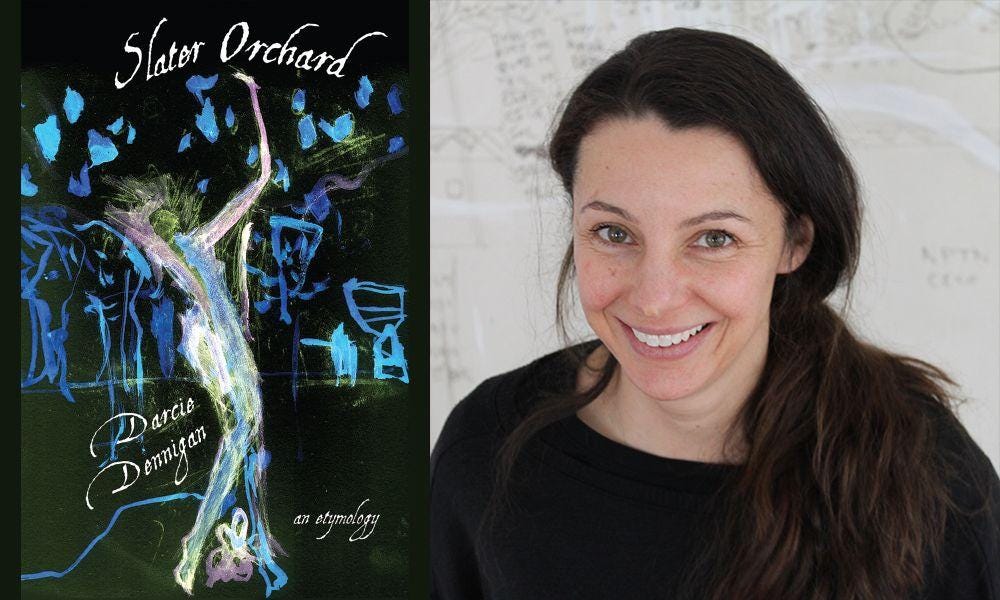
Darcie Dennigan is a novelist and poet, and a critic at large for Annulet. Her most recent book is Slater Orchard. She lives in Providence, RI, where she co-directs the Spatulate Church Emergency Shift.
Looking for more writing inspiration?
I have a brand new workshop series I’m offering this summer (winter in Australia!). It’s called the WILD CRAFT SERIES. And I have a new pricing structure to make these workshops available to everyone, starting at $29! You can also buy a SEAON PASS and get all three workshops at 20% off.
HOW THE F*CK DID THEY DO THAT?: Sometimes you read a book that’s so good you wonder, “How the f*ck did they do that?” In this workshop, we’ll answer that question. The book will change each season. In the summer session, we’ll look at Paul Lynch’s novel Prophet Song. We’ll study three passages from Lynch’s extraordinary book, break down what’s happening, and do exercises to practice those new techniques. (You don’t have to read the book to participate!)
CRAFT DEEP DIVE: DIALOGUE: In this workshop, we’ll look at a different aspect of craft every season. For the Summer session, we’ll explore dialogue – why it matters (philosophically and practically) and how it creates tension, reveals character, and carries emotional weight. I’ll give a short craft talk, then guide you through exercises to help you experiment with dialogue in new ways.
REVISION LAB: This workshop is designed to make the revision process more visible. Writers will have the opportunity to submit 2-3 pages of work. Using a random selection process, I’ll choose two pieces for a live “hot seat” revision session. After that, I’ll guide the whole group through a series of generative exercises to help you revise your own work.
Interested in other Word Project Workshops?
There is room in RIGHT TO WRITE, the monthly generative writing workshop series. Two hours of generative writing prompts on a theme, every month. I love this workshop, and if you miss the live sessions, they are recorded.
There are also four spots left in the upcoming WORD RIVER, which starts in August. The RIVER is 6-months of twice-monthly workshops. If you’re looking to finish a project, if you’re looking for accountability and community, if you’re looking for ongoing support, this is for you.
I really enjoyed this chat. Thanks 🙏